As the EFFEA Generation #4 is concluding and we gradually approach the final months of this Generation, on 22 September 2026, artists, festivals, EFFEA Jury and Platform Members came together to reflect on the EFFEA experience from their different perspectives.
Since January 2026, EFFEA Generation #4 residencies have been taking place across 34 countries. Some residencies have already come to an end, while others will continue until December 2026. Fifty projects have been brought to life by 150 artists and 147 festivals in remarkable ways: discover them here.
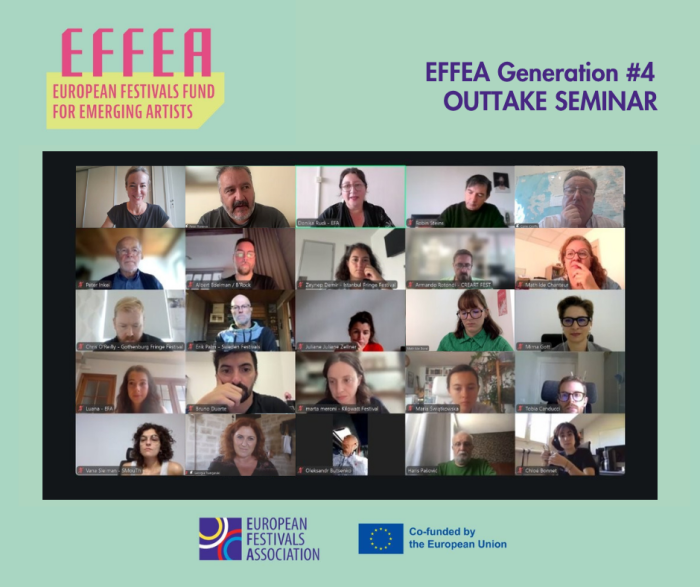
The EFFEA Outtake Seminar Generation #4 offered an opportunity to look at what has happened so far, and at the relationships, artistic developments and new opportunities that may continue beyond the residency period. This idea was already present in the opening words of Kathrin Deventer, Secretary General of the European Festivals Association (EFA), who framed the seminar not as a conclusion, but as a moment to recognise and thank this generation of artists and festivals.
Ms Deventer also placed EFFEA within the wider structure of EFA and its European network of festivals. Together with EFFEA’s Platform Members across Europe, the programme creates connections between the European, national, regional and local levels, helping the call reach festivals and artists across different contexts. At the centre of this structure are festivals themselves: organisations that create spaces and opportunities for artists to perform, experiment and develop their work. She also underlined the importance of continuing the conversation at European level to secure the future of EFFEA, its networks and platforms, and the funding that makes this cooperation possible.
ForDonika Rudi Berishaj, EFFEA Project Director, the seminar was above all a chance to hear what artists and festivals had experienced throughout the year. Generation #4 has seen artists travel across countries, take part in different programmes and artistic contexts, and develop their work through encounters with new audiences and partners. At the same time, festivals have been connecting with one another, reflecting what lies at the heart of EFFEA: working together to support emerging artists. Rather than saying goodbye, Donika invited participants to see the gathering as another moment of connection and an opportunity to think about where and how they might meet and collaborate again.
Haris Pašović, EFFEA Chair of the Jury, returned to the origins of the programme and the need that inspired it. He recalled how the idea behind EFFEA responded to a clear challenge: emerging artists need time, space and opportunities to develop their practice at a stage when they are still researching, experimenting and finding their artistic direction. If navigating the cultural sector can already be difficult for established artists with recognised work and existing networks, those opportunities are even more crucial for artists at the beginning of their careers.
Looking back at four generations of EFFEA, Mr Pašović reflected on how quickly this model of cooperation between festivals was embraced by both artists and festivals, as well as recognised at European level. For him, its development has demonstrated the value of an architecture that brings festivals together around a shared commitment to emerging artistic talent. Reflecting on EFFEA’s achievements within the wider European cultural landscape, he highlighted this recognition:
“EFFEA is one of the three best programmes of Creative Europe.”
— Haris Pašović
EFFEA Jury and Platform Members
What makes a strong international artistic collaboration? What makes an application communicate its potential? These questions shaped the first conversation, moderated by Mirna Gott from the EFFEA Platform Member Croatian Composers Society, with contributions from colleague EFFEA Platform Members: Erik Palm - Sweden Festivals , Colm Croffy - Association of Irish Festivals & Events, and EFFEA Jury Member Peter Florence.
Their different perspectives converged on something that cannot necessarily be reduced to project plans, budgets or international partner lists: the quality of the relationships and the artistic ideas behind them.
For Peter Florence, one of the lessons emerging from the Jury’s experience has been seeing how successful collaborations can generate new partnerships and projects year after year:
“We’ve seen people being imaginative, daring and making friendships that last. One of the abiding lessons for the jury is seeing people who are very good at collaborating, initiating new projects with new partners every year, and I think that’s smart.”
— Peter Florence
The importance of these relationships was also highlighted by Mr Croffy, who reflected on the trust that has developed between emerging artists and festival professionals through the programme:
“What I’ve been pleasantly surprised about is how much the fostering of trust and confidence amongst the next generation of art makers and festival producers this whole process has involved.”
— Colm Croffy
Beyond the relationships themselves, Colm Croffy pointed to the artistic value behind successful collaborations. What stands out, he suggested, is when the partnership creates genuine value for the artist, their artistic practice and the festivals involved:
“What’s adding value to their career, to their art form, and to the festivals that are engaged in the partnerships always seems to shine through. And the integrity of the artistic expression and artistic endeavour, allied with the honesty of the festival, the venue, the platform, the residency…”
— Colm Croffy
The conversation also acknowledged that artists and festivals do not work under identical circumstances. Haris Pašović reflected on the importance of considering the different contexts and countries applicants come from, alongside artistic ambition and innovation.
EFFEA Festivals and Artists
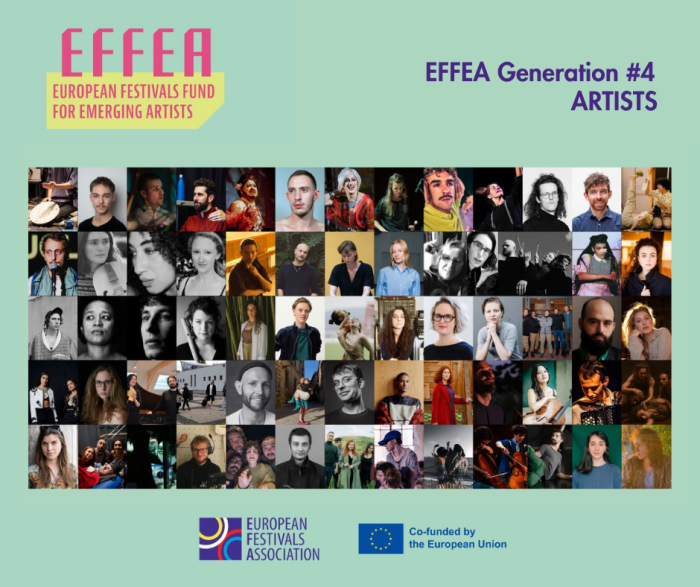
The second part of the seminar brought the experiences of EFFEA festivals and artists to the centre of the conversation. Moderated by Colm Croffy, participants reflected on what taking part in EFFEA had meant in practice: from finding partners and developing new work to reaching audiences and creating opportunities beyond the original residency.
For Michael Dain from Chaillol Festival in France, EFFEA provided an entry point into European cooperation. The experience allowed the festival to discover projects and organisations from regions beyond its existing network, while artists were able to go deeper into the development of their repertoire and artistic work.
“Being in touch with the international community opens the perspective. It is a benefit for the artists and also for Chaillol as a team.”
— Michael Dain
Fanni Nánay from PLACCC Festival in Hungary, participating in EFFEA for the third time, reflected on how partnerships were developed and on using FestivalFinder.eu to identify potential collaborators.
Similarly, Artur Malke from All’improvviso in Poland spoke about the initial challenge of finding partners and co-production opportunities. Through the connections created around EFFEA, festivals can become platforms for further collaborations rather than simply hosts for individual residency activities.
The effects of these exchanges also reach beyond the organisations involved. Robin Stein from AMUZ Festival in Belgium brought the audience perspective into the discussion, reflecting on how international artistic encounters can influence the experience of festival audiences.
For artists, meanwhile, the value of the programme can be something more fundamental: having the conditions to create. Artist Georgia Tsangaraki, supported by EFFEA for the second time, spoke about how this support had given her the time, calm and space to focus on the work she wanted to develop.
Some of the experiences shared during the seminar showed how these relationships can continue growing beyond the initial EFFEA framework.
Roberto Ianni from Festival I Cento Passi described a project that developed throughout the year through online exchanges and residency periods in different countries. Following months of meetings between the artist and partner festivals, the collaboration will continue in Évora, Portugal, in October and conclude with an intensive residency in L’Aquila in November.
“We have truly built a network of people, artists and festivals that is now producing something meaningful and exciting” he wrote during the seminar.
Another example came from Armando Rotondi of CreArt Festival in Spain, who shared the experience of the residency of artist Jacob Gómez, developed with partners in Italy, Croatia and Greece.
During the residency, Jacob Gómez created the dance film Effetti, presented in Croatia, delivered masterclasses on his creative process in Italy and Greece, and took part in networking sessions across the participating festivals. According to Mr Rotondi, these activities generated opportunities well beyond the four partner institutions. Mr Gómez subsequently received invitations from other festivals and participated in performing arts markets.
The experience illustrates a recurring idea throughout the seminar: the residency itself may be temporary, but the connections it creates do not necessarily end with it.
Francesca Tranter from Dance Festival Malta captured this idea in her contribution:
“EFFEA is so much more than a platform of artists and festivals, it creates connections, opens doors and builds a stronger, more generous European artistic community.”
Generation #4 continues
Generation #4 is not over yet. Residencies will continue until December 2026, meaning that some of the collaborations discussed during the seminar are still developing. Before closing the session, we looked towards what comes next: leading festivals will submit the final residency reports, residency films will be uploaded on EFA’s YouTube playlist for EFFEA Call #4, artists and festivals are invited to share their stories with a wider community. There are also many opportunities on the horizon: festivals and artists can apply for EFFEA Call #5 and Perform Europe; next year EFA’s annual rendezvous, the Arts Festivals Summit, will take place in Athens, from 17-21 April 2027.
Connect with us
EFFEA Facebook
EFFEA Facebook Community
Send us an email: info@european-festivals.eu
EFFEA is an initiative of the European Festivals Association, co-funded by the European Union, implemented in partnership with the EFFEA Platform Members: Croatian Composers Society (Croatia), Culture Matters (Czechia), PLMF Arts Management (Estonia), France Festivals (France), Festival Friends (Germany), Stichting Caucasus Foundation (Georgia), Summa Artium Kultúra Támogató Nonprofit Kft. (Hungary), Association of Irish Festival Events (Ireland), ItaliaFestival (Italy), ARC Research and Consultancy Ltd. (Malta), Asociația Centrul Cultural Clujean (Romania), ArtLink (Serbia), Sweden Festivals (Sweden), Development Centre "Democracy through Culture" (Ukraine). Associated Partners: Culture Action Europe, European Music Council, Pearle* Live Performance Europe, Circostrada, IETM, On the Move, European Dance Development Network, Művészetek Völgye Nonprofit Kft.