Residency of Marcus Peter Tesch hosted by Dramatiker|innenfestival Graz, in partnership with Fringify - Independent Arts Festival Hamburg and 180° - Laboratory for Innovative Art Festival.
DIRTY WATERS is a residency by theatre author Marcus Peter Tesch, in collaboration with sound artist Roberto Maqueda and theatre maker, researcher and artist lynn t musiol. In cooperation with the Dramatiker|innenfestival Graz, Fringify – Independent Arts Festival Hamburg and the 180° Festival Sofia, a draft of the text was developed and presented for the first time as a work in progress at Forum Stadtpark in Graz and Theater Altes Heizkraftwerk in Hamburg.
I began my research by looking for narratives around the visibility and disappearance of queer bodies, places, and communities by the water, exploring different regions of Europe, investigating diffuse soundscapes between historical narratives, personal memories, urban legends, and gossip. DIRTY WATERS emerged from this research as a sound-intensive, essayistic stage format in which different queer European pasts, presents, and futures are brought into connection, and listening is explored as a political practice.
My initial research was guided by questions such as:
Where and how did homosexuals live out their identities and form communities at the beginning of the twentieth century, and what parallels can be found across different European regions?
What role did bathhouses play as real and imagined sites of queer memory?
And what role do social status, background, and class play in the possibility of living out one’s sexual identity?
During an initial phase of research into queer memory culture in Vienna and Budapest, I met with two historians from QWIEN. QWIEN is an independent research centre and archive dedicated to documenting and communicating the history and culture of LGBTIQ+ people in Austria. It was fascinating to gain insights into Austro-Hungarian bathing culture and hygiene practices. More disturbing was the realisation that much of what we know today about gay bathing culture and cruising comes from Gestapo records produced in the course of the persecution and deportation of homosexual men.
In response, the focus of my writing process shifted. I became less interested in thermal baths and increasingly drawn to natural waterside environments: floodplains, strips of riverbank, and wetlands that resist direct economic use.
This led to new questions:
How can queer communities be understood not only as victims of political circumstances, but as actors who actively shape and transform their environments?
How can queer history be told not only as a history of social stigma and discrimination, but also as a history of self-empowerment and social agency?
And what connects the geographical shaping of a landscape with the graphic shaping of a text?
As part of this further research, I came across Vienna’s Danube Island, an artificial island constructed in the 1970s between the Danube and the New Danube, which lies several metres lower. It is also home to the so-called Toter Grund, a gay cruising area – a place whose location close to the city makes it highly accessible and inclusive. The Danube itself runs through ten countries, connecting Central, Western, and Southeastern Europe.
From this place, the writing of the text increasingly became a form of literary cartography of an ambiguous territory, constantly shifting between flooding and reconfiguration. Toter Grund became a formal principle for the work: writing as a geographical process, as surveying and mapping. An important impulse here was my meeting with sociologist Max Sohm and my engagement with queer forms of landscape-making such as Toter Grund in the context of his research project “Am anderen Ufer+.
The work on the text thus developed into an essayistic and reflective investigation of landscape, body, and language as systems that are displaced into, overlap with, and extend one another. DIRTY WATERS became a project in search of a form of speech that moves beyond national linguistic appropriations, instead attempting a fluid narrative that develops its own transnational sound.
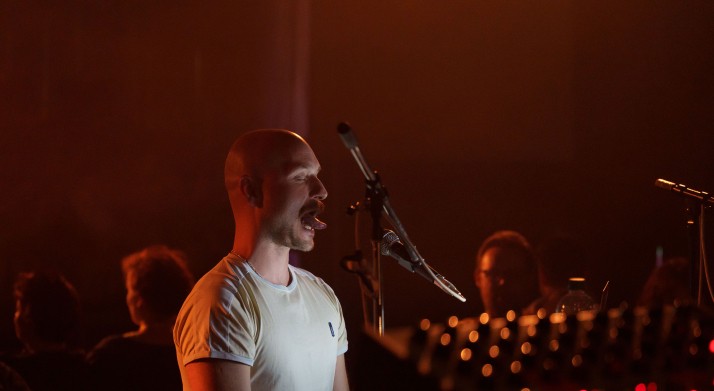
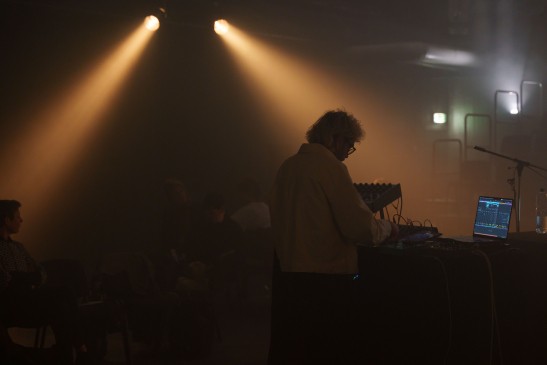
Working with sound artist Roberto Maqueda brought unexpected impulses to the writing process and enabled a new exploration of the musicality of spoken language. The text became material that could be continually reshaped and musically arranged – moving between different sonic qualities of water, between flowing and streaming, dripping and reverberating, between sound, noise, and a pressing beat that suddenly ebbs away. A musical current from which documentary or autofictional fragments of text can repeatedly emerge.
This process also led to the development of a new stage genre for us, which we called the Lecture Concert – a hybrid of lecture performance and new music concert, a performative format in which the visual stimulus is less important than listening and sound.
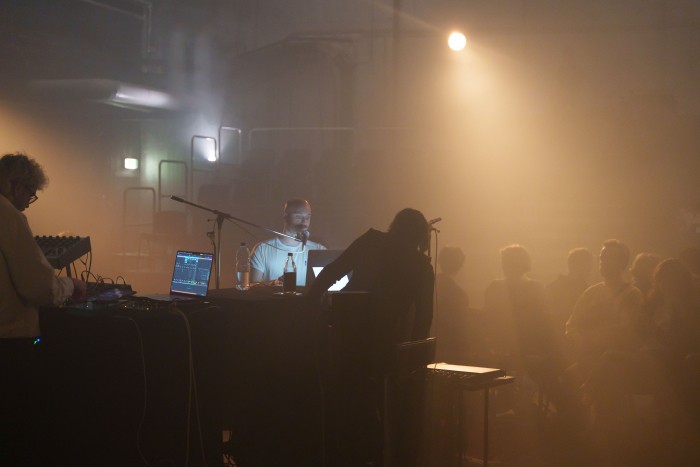
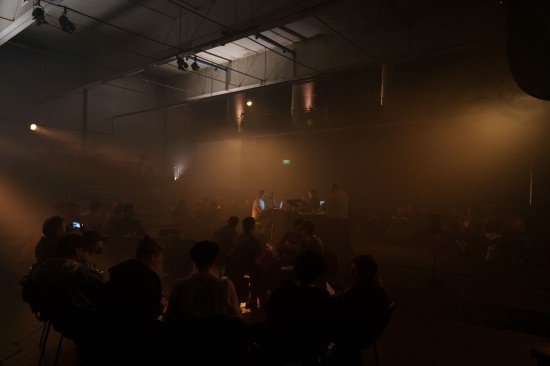
The work-in-progress presentations in Graz and Hamburg were a central part of the residency. Between the two showings, the text and music developed considerably. As both presentations ended in a party, DIRTY WATERS became a starting point for an exchange between audiences and artists – while also functioning as a community event that continued late into the night.